Massage Gun Buyer's Guide: Questions to Ask Before You Choose
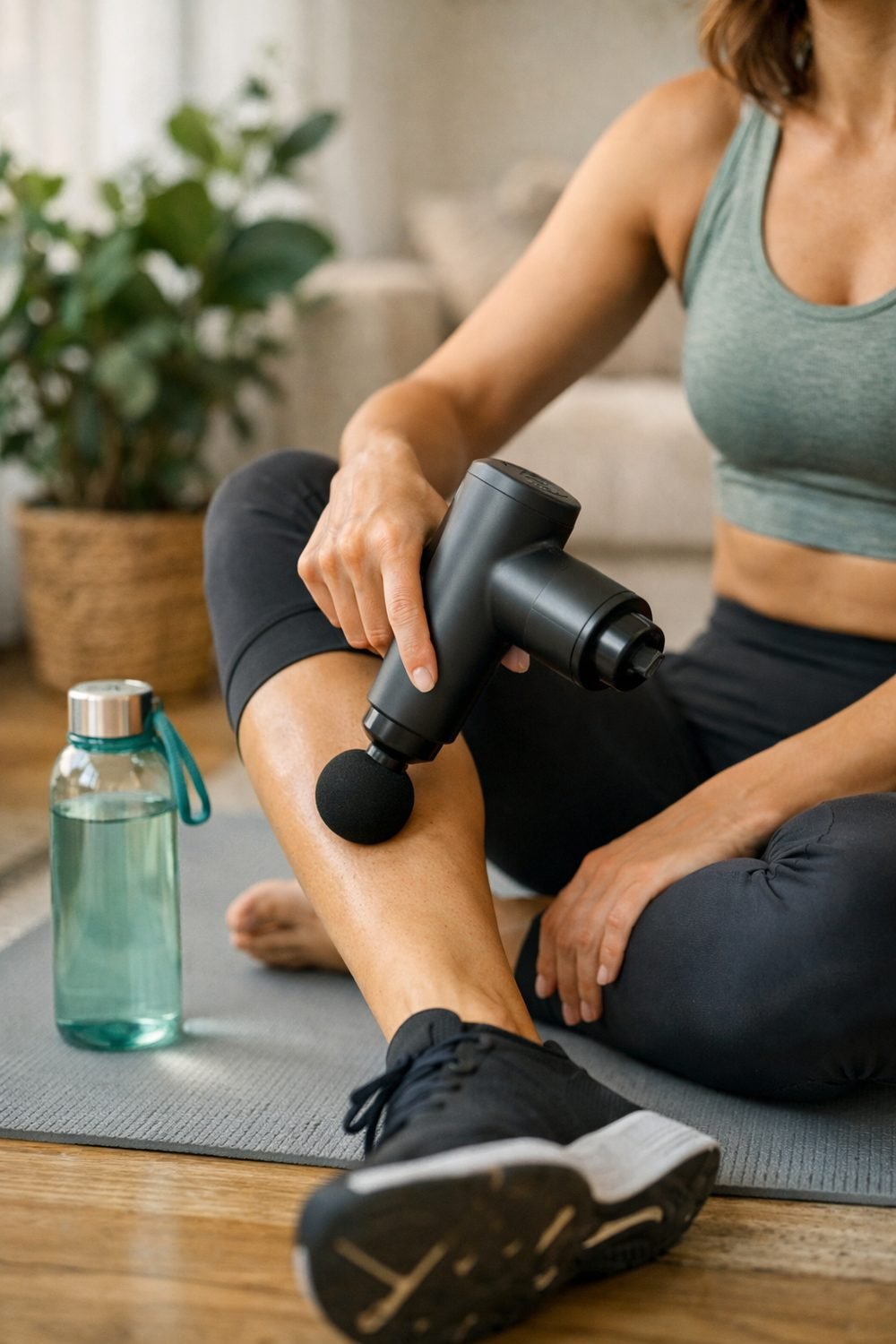
Finding the best massage gun is tricky because handheld massagers vary a lot in size, noise and attachments. Many buyers learn this the hard way. A big, heavy model that sounds like a leaf blower often ends up living in a drawer. The second one I chose more carefully, and I still use it most evenings after a long day at the desk.
This guide walks you through the questions I wish I'd asked before buying the first time. This guide won't tell you which brand to buy. I'll help you figure out what matters for you, so you can read a product page and spot the specs that count and the ones that are just there to sound impressive.
Short on time? Our top picks: Theragun Mini, Theragun Prime, Hypervolt by Hyperice and Hyperice Hypervolt Go. See all picks
Massage gun buying guide: quick summary
Short on time? Here's the short version:
- Start with how you'll use it. Quick relief at your desk needs a different tool than deep work on big leg muscles.
- Hold the weight in your mind. A heavy gun gets tiring fast, especially when you reach your own back.
- Check the noise. If you live with other people or like to use it while watching TV, this matters more than you think.
- Look at amplitude and stall force, not just "speeds." More speed settings doesn't mean a better massage.
- You don't need ten attachments. Two or three good ones cover most needs.
- Read the return policy and warranty before you pay, not after.
- If you have a health condition, are pregnant, or take blood thinners, ask a doctor or physical therapist first.
How to Choose a Massage Gun: What Do You Want It For?
This sounds obvious, but it's the question most people skip. It's an easy mistake to make. A common mistake is buying a gun built for athletes when all you really want is something to ease a stiff neck and tight shoulders after work.
Everyday tension
If your main problem is sitting too long, a stiff upper back, or sore calves after a walk, you probably don't need the most powerful gun out there. A smaller, quieter model often feels nicer on these areas. Big guns can feel harsh on bony spots like the shoulders.
Workouts and sports massage gun needs
If you lift weights, run longer distances, or play a sport, you might want more depth and power for thighs, glutes and calves. These are big muscles, and a weak gun can feel like it's just tickling the surface.
Portable massage gun for travel and the office
Want to toss it in a gym bag or keep it at work? Then size and noise jump to the top of your list. A mini gun that fits in a jacket pocket, like the Theragun Mini, will get used. A big one in a hard case usually stays home.
Here's a quick way to decide. Picture the exact moment you'd reach for it. Is it on the couch at 9 p.m.? Right after a run? At your desk between calls? That picture will guide almost every other choice in this guide.
How Heavy Is Too Heavy?
Weight is one of those things that doesn't seem like a big deal in the product photos. Then you try to work on your own lower back for five minutes and your arm starts to burn.
Full-size vs. mini massage gun
Full-size guns, such as the Hypervolt, tend to feel solid and steady. That can be nice on your legs, because the weight of the gun does some of the work for you. But on your shoulders, neck or back, a heavy gun is awkward to hold at an angle.
Mini guns are lighter and easier to handle. The trade-off is usually a bit less power and a smaller battery. For a lot of people, that's a fair deal.
Handle shape
Some guns have a straight handle. Some have a triangle-style handle that gives you more ways to grip it. A few have handles that bend or rotate. If you plan to massage your own back, look for a handle that lets you reach behind you without twisting your wrist into a pretzel.
Unless you have someone to help you, a lighter gun with a good grip beats a heavy, powerful one you can't hold comfortably. Check the weight listed on the seller's page and compare it to something you already own, like a water bottle or a can of soup, to get a feel for it.
How Loud Is It, Really?
Noise was the reason my first gun ended up in a drawer. A noisy gun can lead a partner or housemate to ask you to stop using it during movies. Fair enough. It was loud.
What to look for
Some sellers list a decibel level. That's helpful, but keep in mind it's usually measured under their own test conditions. A gun pressed hard into a thick muscle may sound different from one running in the air.
Massage gun reviews are often more useful here. Look for comments from people who use it in shared spaces, like apartments or offices. Phrases in reviews like "I can use it while my kids sleep" or "it's louder than I expected" tell you more than a number.
Noise and power go together
In general, more powerful guns tend to be a bit louder, though a well-built motor can help a lot. If you want a deep tissue massage gun that is also quiet, expect to look a little harder and read more reviews.
If you only ever use it in the garage after a workout, noise might not matter much to you at all. That's fine. Just be honest with yourself about where it'll live.
What Do Power Specs Mean?
This is where product pages get confusing. You'll see words like amplitude, stall force, percussions per minute and speed levels. Here's what they mean in plain terms.
Amplitude (or stroke length)
This is how far the head moves back and forth each time it hits. A longer stroke usually feels deeper. A shorter stroke feels more like a fast, light tapping. Neither is "better." Deep strokes feel great on big leg muscles. Shorter strokes can feel kinder on smaller or more sensitive areas.
Stall force
This is how hard you can press before the motor slows down or stops. If you like to lean into a muscle, a low stall force will frustrate you, because the gun will bog down. If you prefer a lighter touch, this matters less.
Speed settings
This is the spec I think is the most overrated. Some guns have a lot of speed levels, and it sounds great on the box. In real life, most people use two, maybe three. What matters more is that the lowest setting is gentle enough and the highest one is strong enough for what you need.
A simple comparison
Think of it like this:
- Gun A has many speed levels but a short stroke and a low stall force. It'll feel buzzy and may stall when you press in.
- Gun B has only a few speeds but a longer stroke and better stall force. It'll likely feel deeper and more satisfying on your thighs.
For most people who want real relief on bigger muscles, Gun B is the smarter pick, even though Gun A looks fancier on paper.
Not every seller lists all of these specs. If one is missing, it's okay to email or message the seller and ask. If they can't tell you, that tells you something too.
Which Attachments Do You Actually Need?
Some guns come with a big bag of heads in different shapes. It looks like great value. Many people find that most of them end up unused.
The ones I use most
- Ball head: The all-rounder. Good for big muscle groups and a nice place to start.
- Flat head: A firmer feel over larger areas. I like it on my thighs.
- Bullet or cone head: For a small, focused spot, like a knot near the shoulder blade. Go gently with this one.
The ones I'd skip
Fork-shaped heads are meant to go around the spine or the Achilles area. Some people love them. Some people find them awkward. Cushioned or soft heads can be nice if you're sensitive, so if that's you, look for one that includes a softer option.
A quick tip while we're on the subject of small habits that make life easier: if you like simple routines, you can grab my free 3 Meal Prep Idea Cards for breakfast, lunch and dinner when you join the email list.
Material and fit
Check whether the heads are hard plastic, rubber, or foam. Foam can feel softer but may wear out or soak up sweat over time. Hard plastic and rubber are usually easier to wipe clean. Also make sure the heads click in firmly. A loose head that rattles is annoying and can make the gun louder.
How Long Does the Battery Last?
Most people only use a massage gun for a few minutes at a time. So a giant battery isn't always a must. Still, nobody likes grabbing it after a hard day and finding it dead.
Questions to ask
- How long does it run on a full charge, according to the seller?
- How long does it take to charge back up?
- What kind of charger does it use? A common USB-C cable is easier than a special round plug you'll lose.
- Does it show how much battery is left?
- Can the battery be replaced, or is it sealed in?
Keep in mind that battery life claims are usually based on lower speeds. If you always use it on high, expect less time. That's normal.
The charger type matters more to me than people expect. A special charger left behind in a hotel room can mean going without your gun for weeks. Now I prefer models that charge with the same cable as my phone.
Is It Built to Last?
This one is hard to judge from photos. A shiny product page can hide a flimsy gun. Here's how I try to sort it out.
Read the negative massage gun reviews
It helps to go straight to the one-star and two-star reviews. You're not looking for people who just didn't like the feel. Look for patterns. Are lots of people saying it stopped working after a few months? That the battery faded fast? That a head snapped? One complaint is normal. The same complaint over and over is a warning.
Warranty and returns
Check how long the warranty lasts and what it covers. Some cover the motor but not the battery. Some need you to register the product. Also read the return policy. Can you send it back if it just doesn't suit you, or only if it breaks? Do you have to pay return shipping?
It can be worth paying a bit more for a gun from a seller with a clear, fair return policy. It takes the pressure off. If it's too strong or too loud, you're not stuck with it.
The carry case
A case is nice for keeping heads together and protecting the gun in a bag. If you'll keep it at home, a case is a bonus, not a reason to pick one gun over another.
Should You Check With a Professional First?
This isn't medical advice, so check with a doctor if you have health concerns. But I think it's worth saying plainly: massage guns are strong tools, and they aren't right for every person or every body part.
When to ask first
Talk to a doctor or physical therapist before using one if you're pregnant, have a heart condition or a pacemaker, take blood thinners, have a recent injury, have problems with your veins or blood clots, or have any condition you're unsure about. They know your situation. A product page doesn't.
Places to avoid
Most sellers warn against using the gun on the front of the neck, directly on bones, joints, or the spine, and on bruised or swollen areas. Read the safety section in the manual or on the seller's page. It's usually short and worth the two minutes.
A common mistake for beginners is using it too long on one spot, which can leave you sore the next day. Less is often more. Start on the lowest setting, keep it moving, and see how your body feels the next morning.
Common Mistakes
These are common mistakes, so no judgment here.
- Buying the most powerful gun "just in case." More power isn't better if it's too strong to enjoy or too heavy to hold.
- Getting distracted by the number of speeds. Look at stroke length and stall force instead.
- Ignoring noise. If it bothers the people you live with, you'll stop using it.
- Not thinking about your own back. If you live alone, make sure you can reach the spots you care about.
- Skipping the return policy. You won't know how a gun feels until you try it. Give yourself a way out.
- Pressing too hard, too long. Let the gun do the work. A minute or two per area is plenty for most people to start.
- Trusting only five-star reviews. The detailed middle and low reviews usually tell you more.
- Using it on the wrong spots. Bones, joints and the front of the neck are generally off-limits. Check the manual.
A Simple Way to Make Your Choice
If you're still stuck between a few options, try this. Write down your top three needs in order. For me, it was: quiet, light, and good on my shoulders. Then go through each gun and give it a simple yes or no on each need. The one with the most yeses in your top spots usually wins.
Example: two shoppers
Sam works from home, lives in a small apartment, and gets a stiff neck and upper back. Sam's list is quiet, light and gentle. A mini gun with a soft head and a fair return policy would probably suit Sam well.
Jordan runs a few times a week and wants to work on tight calves and thighs. Jordan doesn't mind some noise and uses it in the garage. A full-size gun with a longer stroke and good stall force makes more sense here.
Same product type, totally different best choice. That's why I don't think there's one "best" massage gun for everyone.
Massage guns worth a look
These are well-known options to put on a shortlist. None of them is the right pick for everyone, so match each one against your own top three needs.
Theragun Mini
Suits people who want a compact, portable gun for a gym bag or desk drawer. Check the weight, battery details and noise notes on the seller's page, since small guns trade some power for size.
Theragun Prime
A fit for people who want a fuller-size gun with a triangle-style handle for easier reach. Check the weight and how the grip feels for your own back and shoulders.
Hypervolt by Hyperice
Suits people who want a full-size gun for legs and bigger muscle groups. Check the listed noise level and read reviews from people who use it in shared spaces.
Hyperice Hypervolt Go
Aimed at travelers and anyone who wants a lighter, pocket-friendly option. Check the attachments included and whether the power suits your larger muscles.
Ekrin Athletics
Worth a look for people who want a gun with a range of heads and a focus on workout recovery. Check the stated stroke length, stall force and warranty terms before buying.
Bob and Brad massage guns
Suits shoppers who want a simple, home-friendly gun without a lot of extras. Check the return policy and which heads are included.
Renpho massage guns
A fit for people shopping for an everyday gun for general tension. Check charging type, battery run time and the safety notes in the manual.
Check current plans and prices on each brand's own site before you decide.
FAQ
Does massage gun price really matter?
Not always. Price often tracks with things like motor quality, battery and warranty, but a mid-range gun can work well for everyday tension. Focus on the specs and return policy that match your needs, and check the seller's page for what's included.
How long should I use it each time?
Many sellers suggest short sessions on each muscle, often a minute or two, and moving the head rather than holding it in one place. Follow the manual for your model. If you have a health condition, ask a doctor or physical therapist what's right for you.
Is a mini massage gun strong enough for beginners?
For neck, shoulders and general desk stiffness, a lot of people find a mini gun is plenty. For big leg muscles after hard workouts, you may want more depth. Reading reviews from people with similar habits to yours really helps here.
Can I use it on my lower back?
Many people use it on the muscles beside the spine, but not directly on the spine itself. Keep it on a low setting at first and keep it moving. If you have back problems or pain that won't go away, talk to a professional before you start.
Your Next Step
Take ten minutes, picture when and where you'd actually use a massage gun, and write down your top three needs. That small step will save you from buying the wrong one like I did. While you're here, grab the free 3 Meal Prep Idea Cards by joining the email list, so you've got easy breakfast, lunch and dinner ideas ready for busy weeks. Then go back to your shortlist with this guide open, check each seller's page for weight, noise, stroke length and the return policy, and pick the one that fits your real life.
1. Decide how you will use it
After workouts, at your desk or while traveling?
2. Compare weight in the hand
A heavy unit gets tiring to hold.
3. Read the stated battery details
Check run time and charging type on the seller's page.
4. Listen for noise notes
Some are quieter than others; read what the seller states.
5. List the attachments included
Different heads suit different areas.
6. Read the maker's safety notes
Follow the instructions and talk to a professional if unsure.
Ready to look?
This is an affiliate link. Prices and terms change, so check the seller's page. General information only, not medical advice.
Want a printable to keep track while you work? Get our free 3 meal prep idea cards - breakfast, lunch, dinner.